
Editorial Feature · WorkSmarter AI
Your Spreadsheet Isn't the Problem. Your Prompts Are.
AI is already embedded in modern finance work; the real divide is no longer adoption, but the gap between generic prompting and structured prompt systems built for repeatable business output.
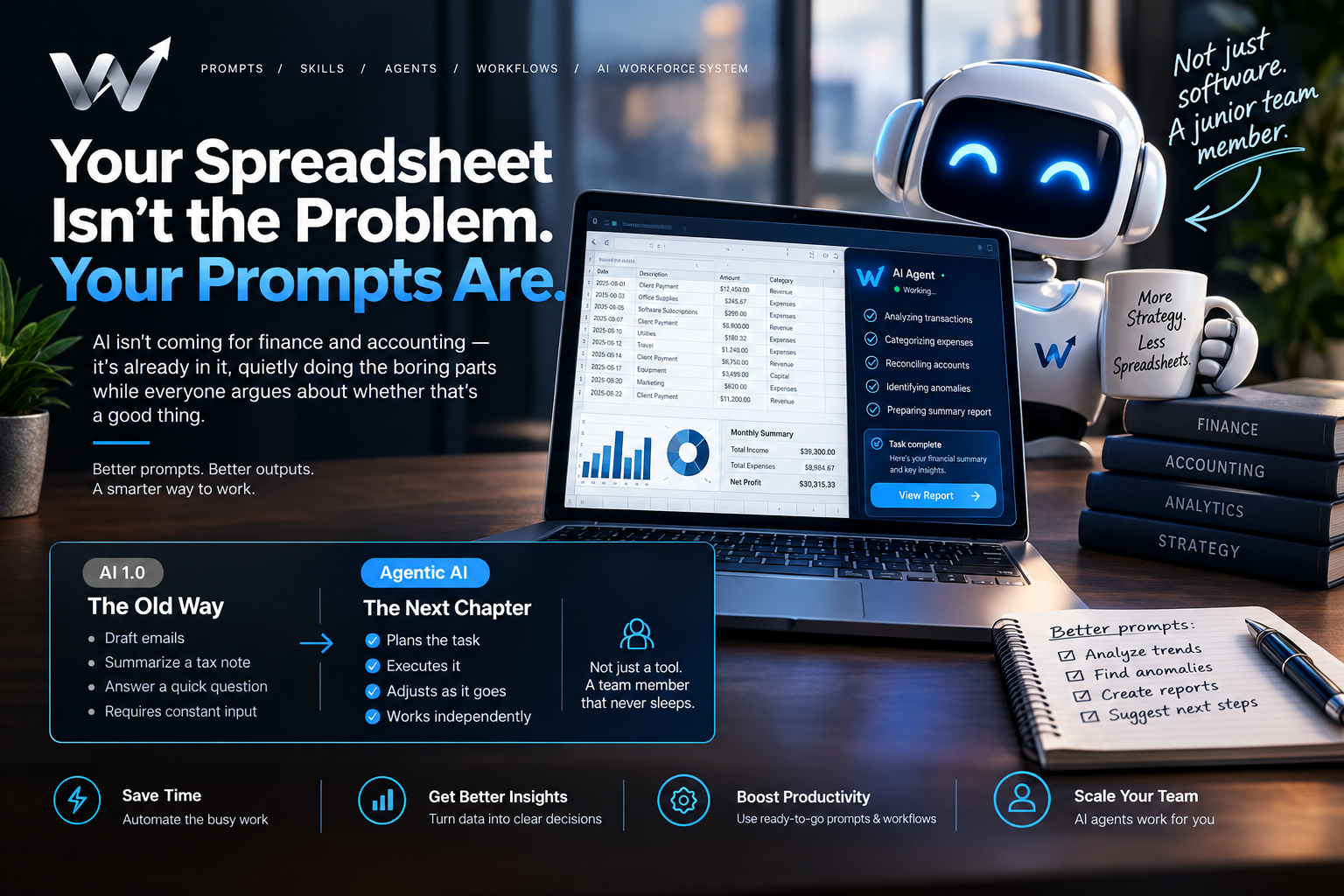
While the market still debates whether finance should use AI, high-performing teams are already using it quietly every day: reconciling repetitive tasks, drafting internal recaps, preparing commentary, and accelerating decision cycles. The difference is not access to models. The difference is instruction quality.
1) AI is already in finance and accounting — just not always visible
Most teams are not announcing AI transformation projects. They are quietly integrating AI into routine execution: transaction review notes, monthly variance summaries, meeting prep, and first-pass communication drafts.
That quiet adoption matters. It means competitive advantage is shifting from "Are we using AI?" to "Are we using it with enough precision to trust the output?"
2) The shift: from chatbot prompts to agentic teammates
Basic chatbot behavior
- • Responds to isolated questions
- • Requires constant manual prompting
- • Produces uneven quality across users
Agentic system behavior
- • Plans work in multi-step sequences
- • Executes tasks with role and context memory
- • Adapts outputs like a disciplined junior or senior digital team member
3) Why vague prompts fail finance teams
No operating context
Generic requests ignore reporting standards, audience expectations, and decision thresholds.
No quality controls
Without constraints, assumptions and numbers drift, forcing expensive human cleanup cycles.
No repeatability
Outputs depend on whoever typed the prompt, making cross-team performance inconsistent.
No structured reasoning path
You get conclusions, not traceable logic that leaders can trust, review, and defend.
4) What finance and accounting teams actually need from AI
Repeatability
Consistent output quality across month-end, quarter-end, and recurring execution cycles.
Control
Clear input constraints, formatting standards, and role definitions that reduce ambiguity.
Auditability
Reasoning and assumption trails that can be reviewed internally before decisions move forward.
Speed
Faster first drafts and shorter turnaround from raw inputs to decision-ready communication.
Clearer reasoning
Outputs that explain tradeoffs, risks, and assumptions — not just polished but shallow language.
Better handoffs
Shared prompt logic that keeps finance, operations, and leadership aligned across workflows.
5) Workflow impact: generic prompting vs system-designed prompting
Finance workflow area
System-designed prompting
Generic prompting
Analysis
Produces structured diagnostics with assumptions, scenarios, and next-step logic.
Returns broad summaries with inconsistent depth and weak prioritization.
Reporting & commentary
Drafts stakeholder-ready narrative aligned to context, audience, and decision intent.
Creates generic language that still requires heavy rewrites by senior staff.
Recap & review
Standardizes recap and review formats so teams can compare periods quickly.
Output format changes each run, slowing review and increasing interpretation risk.
Operational execution
Supports repeatable task flows, clear handoffs, and dependable execution rhythm.
Depends on ad-hoc prompting behavior and individual user skill.
6) Premium prompt systems are operating infrastructure
The most valuable prompt assets are not random lines in a folder. They are structured operating infrastructure: role logic, execution pathways, output standards, and quality controls designed for real business pressure. That is the category WorkSmarter AI builds for professionals who want dependable performance, not demo-level novelty.
If this article reflects your day-to-day reality, explore the marketplace or move directly into implementation with the Financial Prompt Pack — a production-ready system for faster analysis, clearer reporting, and stronger financial execution.
Buy the Financial Prompt Pack